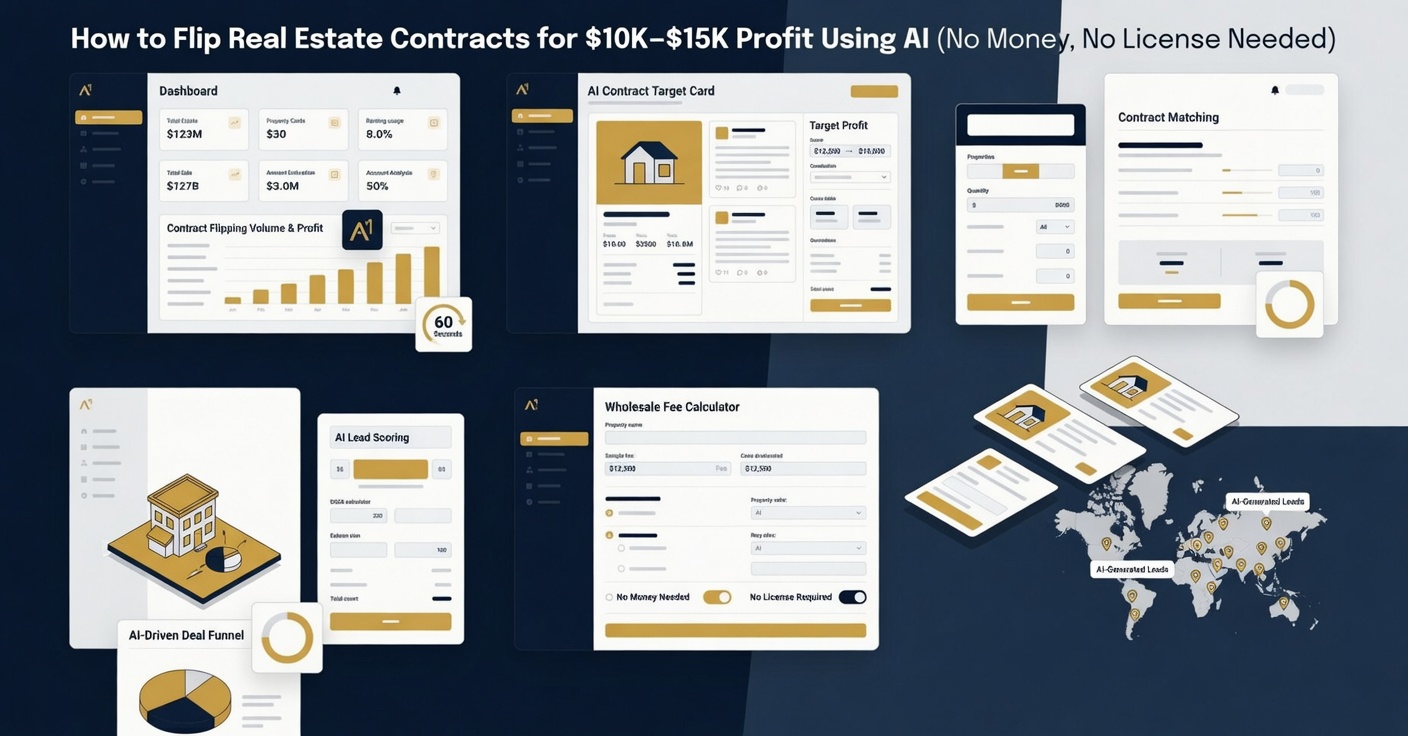
Real estate contract flipping has traditionally been one of the fastest ways to generate income inside the property market without owning real estate, qualifying for mortgages, or committing large amounts of capital. For decades, wholesalers relied on local networks, cold outreach campaigns, and manual lead generation strategies to identify discounted properties and assign purchase rights to investors for a profit. That model still works, but it is no longer the most efficient path available.
Artificial intelligence has changed how deals are sourced, evaluated, and matched with buyers. Instead of spending months building relationships or driving neighborhoods to locate distressed properties, investors can now operate inside intelligent sourcing environments that surface assignable opportunities automatically. This transition explains why interest in learning how to flip real estate contracts using AI has increased significantly among new entrants who want to participate in property investing without traditional barriers.
Today, it is possible to identify off-market opportunities, structure assignable purchase agreements, and connect with buyers in a single workflow supported by data-driven platforms designed specifically for acquisition speed. The result is a contract flipping model that requires less time, less capital, and far fewer operational dependencies than legacy wholesaling systems.
Understanding how this works begins with understanding what contract flipping actually represents in modern real estate investing.
What Real Estate Contract Flipping Means in Today’s Market
Contract flipping, often referred to as assignment wholesaling, is a process where an investor secures the right to purchase a property at a negotiated price and then transfers that purchase right to another buyer for a higher price before closing. The difference between the original contract price and the assignment price becomes the investor’s profit. Because ownership never transfers to the wholesaler, the strategy allows participation in real estate transactions without purchasing the asset itself.
Historically, this process required direct access to motivated sellers and active buyers simultaneously. Investors had to maintain contact databases, negotiate aggressively, and move quickly to avoid losing opportunities. In 2026, the structure remains the same, but the sourcing infrastructure has changed.
AI-powered platforms now identify properties with pricing inefficiencies automatically. Instead of searching manually, investors can review opportunities already aligned with assignment potential. This reduces the most difficult part of contract flipping, which has always been finding viable deals in the first place.
As a result, contract flipping real estate strategies have become more accessible to individuals with limited experience and limited capital.
Why AI Is Transforming Wholesale Real Estate Deals
Traditional wholesaling depended heavily on manual discovery methods such as direct mail campaigns, cold calling, and in-person neighborhood scanning. These methods remain effective but require time, persistence, and operational consistency. Artificial intelligence replaces much of that workload by identifying signals that indicate a property may be priced below investor demand thresholds.
Modern sourcing engines scan ownership transitions, distress indicators, listing inefficiencies, and neighborhood demand patterns simultaneously. Instead of assembling these signals independently, investors can review properties already evaluated for assignment potential. This creates a structured pipeline where opportunities appear continuously rather than sporadically.
The advantage of wholesale real estate deals AI systems is not simply speed. It is consistency. Investors no longer depend entirely on outreach volume to locate opportunities. Instead, they operate within environments where deal flow is filtered according to acquisition logic before it reaches them.
This shift explains how newer investors are entering the contract assignment space without the infrastructure previously required to compete.
Why Contract Flipping Does Not Require Capital Ownership
One of the most misunderstood aspects of wholesaling is the assumption that investors must purchase properties before selling them. In reality, contract flipping involves selling the right to purchase a property rather than the property itself. This distinction allows investors to participate in transactions without financing approval or ownership transfer.
When a property is placed under contract with assignment rights included, the investor can transfer that agreement to another buyer willing to close at a higher price. The buyer completes the purchase, and the wholesaler retains the spread between contract price and assignment price.
This structure is why many investors search for ways to flip contracts for no money. The strategy focuses on negotiation positioning rather than asset ownership. AI-powered sourcing platforms enhance this advantage by identifying properties where pricing gaps already exist between seller expectations and investor demand.
Instead of negotiating blindly, investors begin with opportunities that already contain assignment margin potential.
The Role of Pricing Inefficiencies in Contract Assignment Profits
Assignment profit depends entirely on the difference between acquisition price and investor demand value. If a property can be placed under contract below market expectations, the spread between those values becomes the assignment opportunity.
Artificial intelligence improves identification of these spreads by comparing pricing signals across multiple data layers simultaneously. Rather than relying on intuition, investors can review opportunities where pricing discrepancies are already visible through performance indicators.
This reduces guesswork during negotiation. Instead of estimating whether a property might support assignment profit, investors can evaluate opportunities with built-in margin visibility. That advantage significantly increases the probability of securing contracts that produce five-figure spreads.
The ability to detect pricing inefficiencies quickly is one of the primary reasons AI-driven sourcing platforms are reshaping contract flipping workflows in 2026.
How AI Identifies Assignable Deals Before They Reach the Public Market
Public listings often reflect pricing adjusted by competition. By the time a property appears on major platforms, multiple buyers have already reviewed the opportunity. Assignment margins become smaller as visibility increases.
AI sourcing systems address this limitation by scanning early-stage indicators that suggest a property may enter the market below investor demand value. These signals include ownership duration shifts, financial distress patterns, neighborhood redevelopment activity, and listing behavior anomalies.
Instead of waiting for opportunities to become visible publicly, investors can review properties earlier in the acquisition cycle. This earlier visibility creates negotiation flexibility that supports assignment positioning.
Platforms such as Tranchi AI provide access to these filtered opportunity streams, allowing investors to operate within structured pipelines designed for acquisition logic rather than listing visibility.
This infrastructure dramatically improves the speed at which assignable deals can be identified.
Structuring a Contract That Supports Assignment Rights
Securing assignment rights is essential for successful contract flipping. Without assignment clauses included in the purchase agreement, investors cannot legally transfer the contract to another buyer before closing. AI-driven sourcing platforms simplify this process by presenting opportunities already aligned with assignment-compatible negotiation structures.
Once a property is identified, the investor negotiates a purchase agreement that includes assignment provisions. These provisions allow the investor to transfer contractual rights while maintaining the original pricing structure. The spread between contract price and assignment price becomes the investor’s profit when the final buyer completes the transaction.
Because ownership does not transfer during this process, the investor avoids financing complexity while retaining profit positioning.
This structure is the foundation of modern contract flipping strategies.
Matching Assignable Contracts With Investor Buyers Faster Using AI
Locating buyers used to be one of the most time-consuming parts of wholesaling. Investors maintained email lists, attended networking events, and relied on local connections to distribute opportunities. Artificial intelligence has simplified this process by analyzing buyer behavior patterns and aligning opportunities with investor demand signals automatically.
Instead of marketing deals manually, investors can operate inside environments where acquisition-ready buyers already exist. This reduces the time required to assign contracts and increases the likelihood that deals close within contractual timelines.
Faster buyer matching improves liquidity across assignment workflows. Investors can secure contracts with greater confidence because exit pathways are visible earlier in the process.
This shift explains how five-figure assignment spreads are becoming more common among investors operating inside AI-supported sourcing pipelines.
Why Many First-Time Investors Start With Contract Flipping Instead of Rentals
Rental property investing requires financing approval, property management planning, and long-term capital commitments. Contract flipping removes these requirements by focusing exclusively on acquisition positioning rather than ownership operations.
Because wholesalers do not hold properties, they avoid maintenance costs, vacancy risk, and refinancing exposure. This makes assignment strategies particularly attractive for investors with limited capital reserves who still want exposure to real estate transaction profit structures.
Learning how to flip real estate contracts using AI allows beginners to participate in property markets without committing to long-term ownership strategies. Instead of building portfolios immediately, they generate liquidity through assignment spreads that can later support rental acquisitions.
This staged entry model explains why contract flipping remains one of the most popular strategies among new investors entering the real estate ecosystem.
Understanding the Typical Timeline of an AI-Supported Contract Flip
A modern contract flip follows a structured sequence supported by intelligent sourcing systems. First, the investor identifies an opportunity with assignment margin potential through an AI-filtered deal feed. Second, the investor negotiates a purchase agreement that includes assignment rights. Third, the opportunity is matched with acquisition-ready buyers aligned with the property’s pricing structure. Finally, the contract is assigned before closing, allowing the investor to retain the spread between contract price and buyer purchase price.
Because discovery, evaluation, and buyer matching occur within a single workflow environment, the timeline between opportunity identification and assignment completion is significantly shorter than traditional wholesaling processes.
This efficiency explains how investors are completing multiple assignments within months rather than years.
Realistic Profit Expectations From Contract Flipping in 2026
Assignment profits depend on market conditions, negotiation skill, and opportunity sourcing infrastructure. However, AI-supported workflows increase the probability of identifying spreads within the $10,000 to $15,000 range because pricing inefficiencies become easier to detect earlier in the acquisition cycle.
Instead of relying on occasional discoveries, investors operate inside structured pipelines where assignment margins appear more consistently. This consistency allows assignment income to become repeatable rather than unpredictable.
As sourcing platforms continue improving signal detection accuracy, the frequency of viable assignment opportunities is expected to increase further.
This explains why contract flipping real estate strategies remain one of the fastest-growing entry points into the property investment sector.
Finding Flippable Contracts Using Structured Deal Feeds
The most important step in assignment wholesaling is identifying opportunities that support margin positioning. AI sourcing platforms reduce this challenge by presenting properties already filtered according to investor demand thresholds.
Instead of reviewing hundreds of listings manually, investors can focus on opportunities aligned with assignment logic immediately. This reduces time spent searching and increases time spent negotiating.
You can explore flippable deals directly through the platform of Tranchi AI. Access to structured deal feeds dramatically improves the probability of securing contracts with assignment potential.
Scaling Contract Flipping From Single Deals to Consistent Income
Many investors begin with a single assignment transaction and then expand into repeatable acquisition workflows. AI-supported sourcing systems make this transition easier by maintaining continuous deal visibility across multiple markets simultaneously.
Instead of restarting the discovery process after each assignment, investors remain inside pipelines where new opportunities appear automatically. This creates momentum across acquisition workflows and improves income consistency.
As investors gain experience evaluating pricing spreads and negotiating assignment clauses, they can increase transaction frequency without increasing operational complexity.
This scalability advantage is one of the primary reasons AI-driven wholesaling infrastructure is attracting attention from both new and experienced investors.
Accessing Advanced Deal Discovery Features Through Professional Platforms
Professional sourcing environments provide additional filtering layers that improve assignment accuracy further. These layers include neighborhood demand signals, investor purchase activity patterns, and pricing deviation indicators that highlight opportunities with the strongest assignment positioning.
Investors seeking consistent deal flow often upgrade to advanced sourcing environments that provide deeper visibility into acquisition-ready opportunities.
Wondering the Tranchi AI pricing options? It’s available for Tranchi ai Pro plan
Operating inside structured deal discovery systems significantly improves the probability of identifying assignment spreads within the $10,000 to $15,000 range.
The Bottom Line on Flipping Real Estate Contracts Using AI
Contract flipping remains one of the most accessible ways to generate income inside real estate without purchasing property or qualifying for traditional financing. Artificial intelligence has removed many of the discovery barriers that once limited assignment opportunities to investors with large outreach networks.
Instead of relying on manual sourcing strategies, investors can now operate inside structured pipelines where assignable opportunities appear continuously. This creates a repeatable environment where pricing inefficiencies become visible earlier and buyer matching occurs faster.
For investors exploring how to flip real estate contracts using AI, the fastest path forward is operating within intelligent sourcing platforms designed specifically for acquisition positioning. These environments transform wholesaling from a relationship-driven process into a scalable workflow supported by data-driven opportunity discovery.
Written by
John Kelly
Contributing writer at Tranchi AI, covering real estate investment strategies, DSCR loans, and market analysis.
Ready to Find Your Next Cash-Flowing Deal?
Tranchi AI scans thousands of properties daily, analyzing cash flow, DSCR ratios, and market data so you don't have to.
Browse Deals